

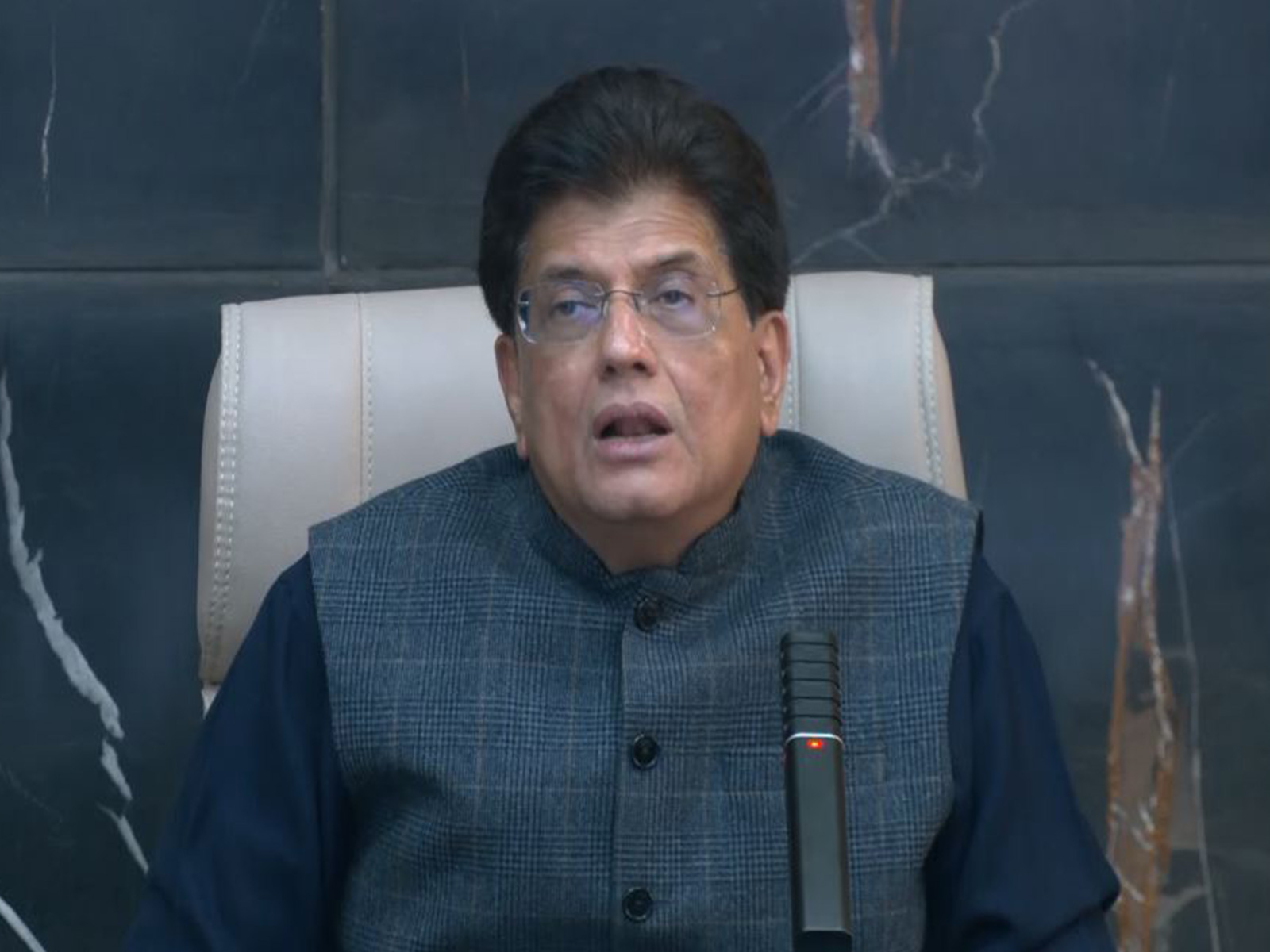
New Delhi [India], December 19 (ANI): Commerce and Industry Minister Piyush Goyal on Friday said the India-Oman Comprehensive Economic Partnership Agreement (CEPA) marks a major shift in India’s trade engagement and will significantly deepen bilateral ties.
Quoting Prime Minister Narendra Modi, in whose presence the trade agreement was signed yesterday in Oman, Goyal said that the prime minister rightly stated that the India-Oman Comprehensive Economic Partnership Agreement (CEPA) will energise bilateral engagement for the 21st century.
Goyal described the agreement as strategically important for India’s long-term economic and geopolitical interests.
Highlighting Oman’s position in the Gulf Cooperation Council (GCC), the commerce minister noted that India is only the second country with which Muscat has signed a Free Trade Agreement.
“Oman is a member of the GCC and had earlier signed a Free Trade Agreement with the United States in 2006. After nearly 20 years, Oman has chosen India as only the second country for such an agreement,” Goyal said.
Goyal underlined the historical depth of ties between the two nations, pointing out that “India was the first country with which Oman ever signed a bilateral agreement. This reflects the importance Oman places on its relationship with India.
The minister said India’s trade policy has been fundamentally reoriented.
“India’s trade strategy has undergone a complete transformation. We are now focusing on countries where we complement rather than compete,” he said, adding that this approach opens up “vast opportunities for our youth, industries, manufacturing sector and services.”
Among the key outcomes of the CEPA is Oman’s decision to allow the export of raw marble blocks to India for the first time. Goyal said this would enable domestic processing and value addition, generate employment, reduce imports of finished marble from countries like Turkey, and ensure better quality at competitive prices.
He also highlighted opportunities in labour-intensive sectors, noting that nearly 700,000 Indians currently reside in Oman and send remittances of approximately Rs 18,000 crore annually.
The CEPA agreement, he said, opens “enormous opportunities,” with Oman keen to collaborate with India in space, food security, pharmaceuticals and manufacturing. Indian pharmaceutical companies will benefit from fast-track approvals and automatic clearances for recognised plants and products.
Mobility provisions have been enhanced, with higher quotas for inter-corporate transfers and longer durations of stay. Indian investments in Oman can also serve as a gateway to the GCC, Africa and parts of Central Europe, with new provisions allowing employment generation for Indian workers within permitted limits, he said.
The CEPA will also promote AYUSH, wellness, healthcare and medical tourism, he added.
This is the 2nd Free Trade Agreement India signed in the last 6 months after the United Kingdom, and is a part of strategy to sign trade agreements with developed economies that are not competing with our labour-intensive interests and provide opportunities for Indian businesses.
The CEPA secures unprecedented tariff concessions for India from Oman. Oman has offered zero-duty access on 98.08% of its tariff lines, covering 99.38% of India’s exports to Oman. All major labour-intensive sectors, including gems & jewellery, textiles, leather, footwear, sports goods, plastics, furniture, agricultural products, engineering products, pharmaceuticals, medical devices, and automobiles, receive full tariff elimination. Out of the above, immediate tariff elimination is being offered on 97.96% Tariff Lines.
India is offering tariff liberalisation on 77.79% of its total tariff lines (12,.556) which covers 94.81% of India’s imports from Oman by value. For the products of export interest to Oman and which are sensitive to India, the offer is mostly a tariff-rate quota (TRQ) based tariff liberalisation.
To safeguard its interest, sensitive products have been kept in the exclusion category by India without offering any concessions, especially agricultural products, including dairy, tea, coffee, rubber, and tobacco products; gold and silver bullion, jewellery; other labour-intensive products such as footwear, sports goods; and scrap of many base metals.
The CEPA further provides for 100 per cent Foreign Direct Investment by Indian companies in major services sectors in Oman through commercial presence, opening a wide avenue for India’s services industry to expand operations in the region. In addition, both sides have agreed to hold future discussions on social security coordination once Oman’s contributory social security system is implemented, reflecting a forward-looking approach to facilitating labour mobility and worker protection.
This is the first bilateral agreement that Oman has signed with any country since United States of America in 2006. (ANI)
Disclaimer: This story is auto-generated from a syndicated feed of ANI; only the image & headline may have been reworked by News Services Division of World News Network Inc Ltd and Palghar News and Pune News and World News

HINDI, MARATHI, GUJARATI, TAMIL, TELUGU, BENGALI, KANNADA, ORIYA, PUNJABI, URDU, MALAYALAM
For more details and packages